
Ontario new-build cash-to-close guide
The Proposed $130,000 Rebate Still Doesn't Tell You What to Bring to Closing
What number might your lawyer ask you to wire before closing?
Short answer
Ontario has announced proposed HST relief that could reach up to $130,000 for certain new homes. That number still does not answer the question you need answered first: how much cash might I need to wire on closing day?
Down payment left, land transfer tax, CMHC PST, legal/title, Tarion, and builder adjustments.
A builder credit can help at closing. A claim-later rebate may help after you have already closed.
Closing day: what might I need to wire?
A rebate headline tells you there may be relief. It does not tell you what your lawyer will ask you to send.
Before you rely on the headline number, check the parts that change your wire:
Price basis
What price am I entering?
Before HST, inclusive of HST, or already reduced by an assigned rebate.
Rebate timing
Did I assign the rebate?
Look for builder assignment or credit wording before assuming the rebate lowers closing cash.
Cash costs
Which costs still need cash?
Some costs are not covered by the mortgage even when the mortgage covers most of the purchase.
Final proof
Which document confirms it?
The lawyer’s funds request and statement of adjustments beat any early estimate.
Your lawyer’s funds request usually comes from three places:
The rest of your down payment after deposits.
Ontario LTT, Toronto MLTT if applicable, and Ontario PST on mortgage insurance.
Legal fees, title insurance, Tarion or warranty amounts, development charges, utility charges, reserve-fund contributions, and credits.
A rebate only helps your closing cash if it shows up in time and in the right place on the closing worksheet.
Use a rebate calculator to estimate one benefit. Use a cash-to-close worksheet to plan the money you may need available before closing.
Use the worksheet
Calculate cash to close before you rely on a rebate headline.
Start with the numbers you already know. Add builder paperwork later when the closing package arrives.
Example ledger: the rebate is only one line
Say you are buying a Toronto new build. You have already paid a deposit, and you still do not know whether the builder will credit the rebate at closing. The exact numbers belong in the ledger below. Price, deposits, mortgage insurance, taxes, and rebate timing all need to land in one place.
The rebate estimate matters. The cash ledger still has more lines.
| Cash-to-close line | Example amount | Why it belongs in the ledger |
|---|---|---|
| Down payment still needed | $45,000 | You planned 10% down and already paid $50,000. |
| Ontario and Toronto land transfer tax | $22,475 | If the home is in Toronto, you can face both provincial LTT and municipal MLTT, less any eligible first-time buyer rebates. |
| Ontario PST on CMHC insurance | $2,120 | The CMHC premium can usually be added to the mortgage, but the Ontario PST on that premium is normally a cash closing cost. |
| Legal, title, Tarion, builder extras, and adjustments | $8,840 | These are planning allowances until the lawyer and builder provide the final documents. |
| Builder rebate timing | Show both cases | A credited rebate can reduce the wire amount. A claim-later rebate may not help until after closing. |
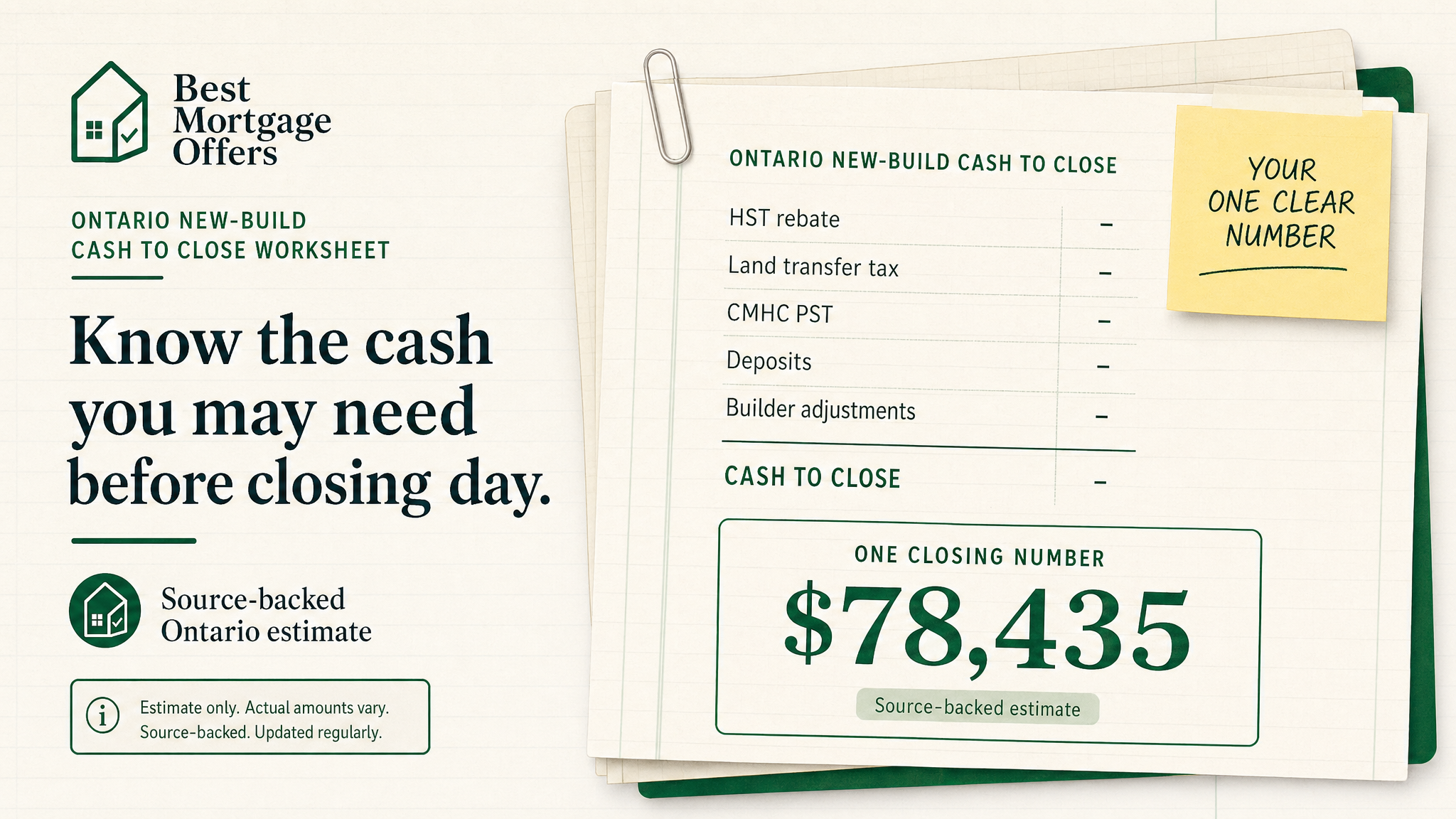
In this setup, plan around roughly $78,435 before rebate timing is confirmed. If the builder credits the rebate at closing, your wire may fall. If you claim later, the rebate may still help, but not before the lawyer asks for funds.
Check the line items
Use the detailed guides when a line item looks unclear.
- Ontario new-home HST rebate guide for the provincial rebate path.
- First-time buyer GST/HST rebate guide for the federal first-time buyer path.
- New-build closing costs guide for legal/title, Tarion, adjustments, and builder extras.
- Ontario LTT, Toronto MLTT, and CMHC PST guides for the tax and mortgage-insurance lines.
Rebate timing: builder credit or claim later?
This is where the surprise usually happens. The same rebate estimate can leave you with two different closing-day cash needs.
| Scenario | What to look for | What it means for your cash |
|---|---|---|
| Builder credits rebate at closing | The statement of adjustments shows a rebate credit or assigned rebate. | Your wire may be lower. |
| You claim later | You close first and apply after closing, where eligible. | You may need to bring more cash up front. |
| Unknown treatment | The agreement or worksheet is not clear yet. | Run both cases until your builder or lawyer confirms it. |
If the rebate is not on the closing statement, plan as if you may need to bring the cash first. When you do not know the treatment yet, the calculator shows both cases so you are not planning from the best-case version only.
Rule of thumb
Ask the builder and lawyer three direct questions: where does the rebate appear, who claims it, and when does the money actually change hands?
For the details behind this split, see the builder credit versus claim-later guide and the net-of-HST builder price guide. If the agreement mentions capped or uncapped municipal charges, pair those with the development charges guide.
Dates: which ones can change the rebate?
Once you know whether the rebate is credited at closing or paid back after closing, the next risk is the date. Agreement date, occupancy date, construction start date, substantial completion date, and final closing date are not interchangeable.
If you are staring at several dates in the agreement, do not guess which one controls eligibility. Keep them separate and ask the builder or lawyer to confirm which date applies to your rebate path.
Rebate windows often start with when the APS was entered into.
Ontario’s proposed enhanced relief uses construction-start timing in its backgrounder.
Some paths include completion deadlines.
This is when the final funds request becomes urgent.
The safest workflow is to enter the dates you know, mark unknowns honestly, and update the estimate when documents arrive.
Documents: where to find each number
You will probably not have every number on day one. That is fine. Start simple, then improve the estimate as your file becomes more complete.
Purchase price $950,000
Agreement date Apr 15, 2026
GST/HST rebate assigned to builder Yes / No
Use the agreement and schedules to confirm price basis, dates, purchaser names, deposits, and rebate wording.
Development charges $4,200
Utility adjustments $650
GST/HST rebate credit $0 or credited amount
Use the statement of adjustments to find the real credits and charges that affect the wire.
Agreement of purchase and sale
Look for price, dates, names, and rebate wording.
Check the price line, agreement date, purchaser names, deposit schedule, GST/HST wording, rebate assignment wording, and any capped or uncapped adjustment language.
Mortgage and deposit records
Separate cash already paid from cash still owing.
Deposits reduce the remaining down payment cash. The mortgage commitment helps you check insured status and whether CMHC PST belongs in the closing ledger.
Tarion, HCRA, and builder worksheets
Find warranty context, dates, and builder extras.
Look for development charges, utility charges, reserve-fund contributions, occupancy fees, and capped or uncapped adjustments.
Statement of adjustments and funds request
Find the final credits, charges, and wire amount.
This is where builder credits, development charges, utility adjustments, rebate timing, and the lawyer’s actual funds request become visible.
The calculator is useful before every document is in hand, but the lawyer’s closing package wins over any estimate.
Rules: what should I verify before relying on the rebate?
The federal first-time buyer GST/HST rebate is confirmed by CRA. CRA says it can eliminate the GST or federal part of the HST for qualifying first-time buyers on new homes valued up to $1 million, with reduced relief between $1 million and $1.5 million. CRA also says the FTHB rebate can act as a top-up where the existing new housing rebate also applies.
The existing GST/HST new housing rebate is separate. CRA’s new housing rebate page explains that eligible purchasers may recover some GST/HST paid on new or substantially renovated housing, and that Ontario’s new housing rebate can still be available up to its maximum even when the federal new housing rebate is not available because the value is above the old federal threshold.
Ontario’s 2026 HST relief is not final in the same way. The Ontario backgrounder describes proposed temporary relief for certain new homes and gives timing tests, including agreement timing, construction-start timing, and substantial-completion timing. Treat Ontario’s proposed relief as not final until your lawyer or builder confirms it applies to your deal.
Other lines in the closing ledger have their own source trail. Ontario publishes land transfer tax rates and guidance on the value of consideration for new homes. Toronto publishes municipal land transfer tax rates and rebates. CMHC publishes mortgage loan insurance cost information, and Tarion publishes new-home enrolment fee information.
What this means for you
Check the rule, then check the cash timing.
- Treat federal CRA rules and Ontario’s proposed relief as separate paths.
- Confirm whether your price is before HST, inclusive of HST, or net of an assigned rebate.
- Ask whether the builder credits the rebate on the closing worksheet or expects you to claim later.
- Re-run the estimate when the statement of adjustments or lawyer’s funds request arrives.
Calculator check: can I trust the number?
A calculator should earn your trust before you use its number. The danger is not only bad math. A tool can calculate the rebate correctly and still miss the cash you need before closing.
Before you trust a rebate or cash-to-close estimate, ask:
- Can I see where the rule came from?
- Does the tool say whether the rule is final or proposed?
- Does it separate federal and Ontario rebate paths?
- Does it show credited-at-closing versus claim-later treatment?
- Does it include LTT, Toronto MLTT, CMHC PST, legal/title costs, Tarion, development charges, deposits, and adjustments?
- Does it tell me which document to check next?
If a calculator cannot answer those questions, it may still be useful for one line. It should not be the whole closing plan.
Reader threads and competitor pages are only context, but they show why this checklist matters. People compare rebate calculators, date windows, HST paths, land transfer tax tools, closing-cost guides, and builder worksheets because no single line item answers the wire-transfer question.
Mock bad pattern
A single rebate number with no source status, no timing, and no closing costs.
You see a large rebate estimate, but the tool does not say whether the rule is final, whether the builder will credit it, or whether land transfer tax, CMHC PST, legal/title costs, Tarion, development charges, deposits, and adjustments still need cash.
Other tools prove that pieces of the problem matter. FTHBCalc is focused on fast rebate estimates. FirstHomeOntario offers separate HST, closing-cost, land-transfer-tax, and development-levy tools. Condo123’s pre-construction guide covers closing-cost details such as development charges, occupancy fees, reserve contributions, legal costs, Tarion, and utility charges. Deeded’s Ontario incentives guide groups first-time buyer incentives in one place.
Those resources are useful. The hard part is turning the pieces into one wire amount for your own purchase.
Workflow: what should I do next?
Use the calculator early, then tighten it before closing.
- Run a first estimate with purchase price, location, dates, down payment, and deposit paid.
- Add whether you are first-time, whether a spouse or common-law partner has owned, and whether the home will be a primary residence.
- Add the rebate timing: credited at closing, claimed later, or unknown.
- Add legal/title costs, Tarion, builder adjustments, development charges, utility charges, reserve-fund contributions, and occupancy fees as documents arrive.
- Ask the lawyer to confirm the final statement of adjustments and the actual wire amount.
The goal is not to replace professional advice. The goal is to make the lawyer’s wire request less of a shock.
Next step
Turn the rebate into a closing-cash estimate.
The calculator keeps the rebate, taxes, insured-mortgage PST, deposits, legal/title costs, Tarion, development charges, and builder adjustments in one browser-based worksheet.
Frequently asked
Is an Ontario HST rebate the same as cash to close?
No. A rebate can reduce tax cost, but cash to close also includes deposits still owed, land transfer tax, Toronto MLTT, CMHC PST, legal/title costs, Tarion, development charges, builder adjustments, and whether the rebate is credited at closing or claimed later.
Why does builder credit versus claim later matter?
A builder credit may lower the amount wired at closing. A claim-later rebate may still be valuable, but you may need to fund closing first and wait for the rebate afterward.
Which dates should I check?
Check agreement date, construction start date, expected substantial completion date, closing date, and any occupancy date. Different rebate paths can depend on different dates.
Where do I find the numbers for a cash-to-close estimate?
Start with the agreement of purchase and sale, deposit receipts, mortgage commitment, Tarion/HCRA documents, builder worksheets, and the statement of adjustments. Your lawyer should confirm the final wire amount.
Sources reviewed
Official sources
- CRA first-time home buyers' GST/HST rebate Official · federal · reviewed 2026-04-28
- CRA GST/HST new housing rebate Official · federal · reviewed 2026-04-28
- Ontario 2026 HST backgrounder Proposal · Ontario · reviewed 2026-04-28
- Ontario land transfer tax rates Official · Ontario · reviewed 2026-04-28
- Ontario value of consideration for new homes Official · Ontario · reviewed 2026-04-28
- Toronto municipal land transfer tax rates and rebates Official · Toronto · reviewed 2026-04-28
- CMHC mortgage loan insurance cost Official · Canada · reviewed 2026-04-28
- Tarion enrolment fee update Official · Ontario · reviewed 2026-04-28
- Ontario housing supply and development charge measures Review needed · Ontario · reviewed 2026-04-28
Market references and reader signals
- Condo123 pre-construction closing-cost guide Market reference · Ontario · reviewed 2026-04-28
- Deeded first-time buyer incentives guide Market reference · Ontario · reviewed 2026-04-28
- FTHBCalc Ontario rebate calculator Market reference · Ontario · reviewed 2026-04-28
- FirstHomeOntario new home buyer toolkit Market reference · Ontario · reviewed 2026-04-28
- Reddit buyer thread on agreement-date cliff Buyer signal · Ontario · reviewed 2026-04-28
- Reddit buyer thread on rebate calculator math Buyer signal · Canada · reviewed 2026-04-28
What to check next